Overview
Montana's ski season runs December through March, and the range of options is wider than most visitors expect. This guide to Montana covers the five resorts that draw out-of-state skiers, but the state's ski landscape stretches from a 5,800-acre destination mountain to no-frills day hills where a powder day feels like a private outing. The anchor resorts are Big Sky Resort in Gallatin Canyon south of Bozeman, Whitefish Mountain Resort above Whitefish in the Flathead Valley, and Bridger Bowl just north of Bozeman. Red Lodge Mountain and Lost Trail Powder Mountain round out the list for skiers willing to drive a bit farther for fewer crowds and lower prices.
One thing that sets Montana skiing apart from bigger resort states: the mountains are spread across a large geography, so picking your base matters as much as picking your resort. Big Sky and Bridger Bowl are both within 90 minutes of Bozeman Yellowstone International Airport (BZN). Whitefish Mountain Resort is about 30 minutes from Glacier Park International Airport in Kalispell (FCA). Red Lodge Mountain is the closest mountain to Billings Logan International (BIL). Plan around the airport you're flying into, and the logistics fall into place.
What to Expect at Each Resort
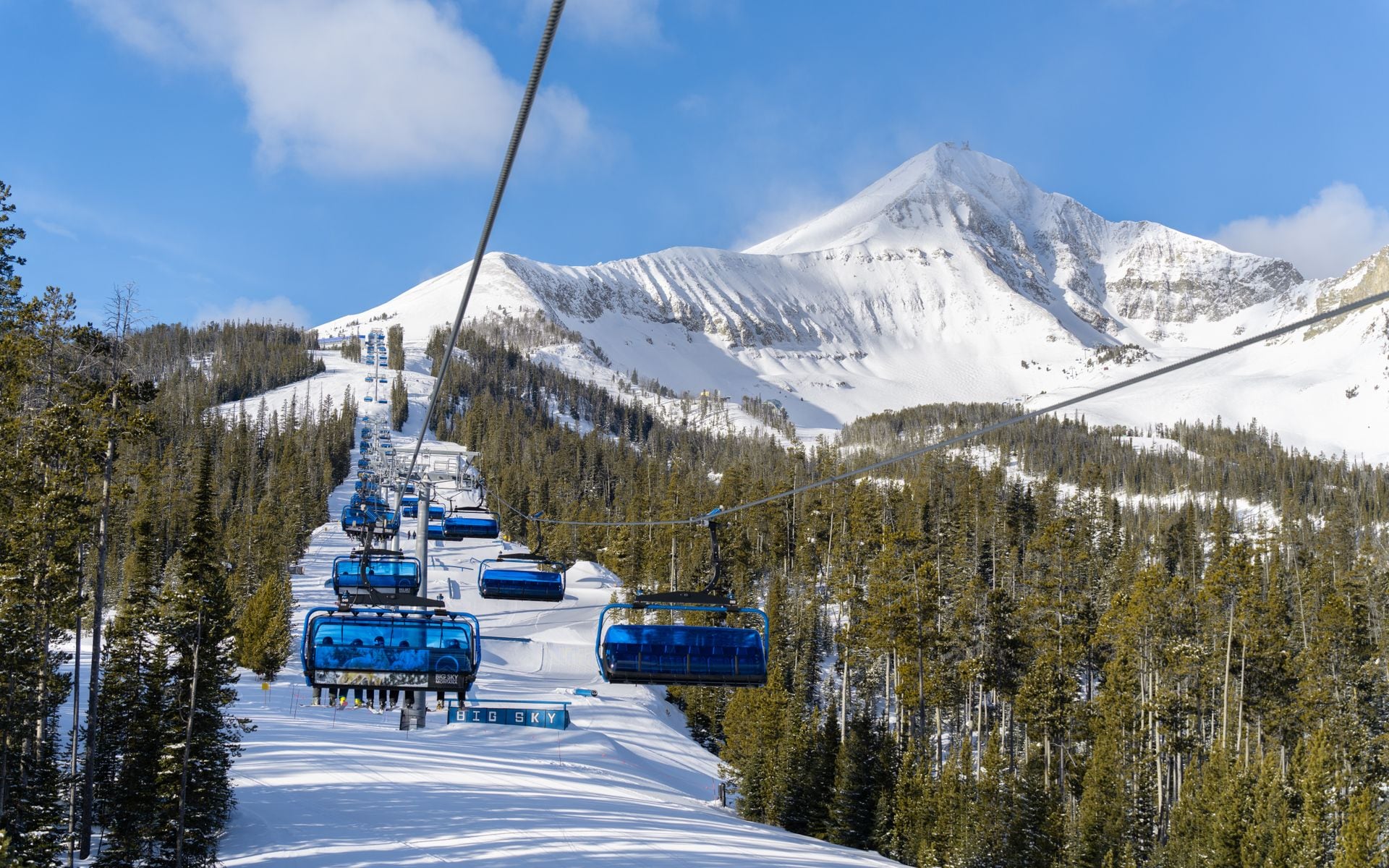
Big Sky Resort sits about 50 miles south of Bozeman via US-191 through Gallatin Canyon, a road that tracks the Gallatin River through a narrow limestone canyon. The drive itself is worth paying attention to: it's one of the better corridors in the state for wildlife watching, and bighorn sheep and moose show up along the river with some regularity in winter. The mountain covers approximately 5,800 acres, tops out at 11,166 feet on Lone Peak, and drops more than 4,350 vertical feet to the base. The combination of raw size and crowd management produces one of the better skiing-to-skier ratios of any large American resort. On a non-holiday weekday you can ski the same run back-to-back and rarely share the chairlift. Big Sky is included on the Ikon Pass, so if you already hold that pass, factor it in when comparing costs. In summer, the Gallatin River running through the canyon below the resort is one of Montana's better runs for whitewater rafting, which gives you a sense of how much the same corridor offers year-round.
Whitefish Mountain Resort, called 'Big Mountain' by locals who grew up skiing it before a name change, covers about 3,000 acres with particularly good tree skiing. The resort's north-facing slopes preserve snow quality well into March, and the gladed terrain stays soft for days after a fresh snowfall when exposed runs have already hardened. The base area has ski-in/ski-out lodging at Kandahar Lodge, a gondola, and several restaurants. The town of Whitefish is 7 miles down the mountain, connected by a free shuttle, and offers a real downtown with independent restaurants, bars, and a walkable main street. One detail most visitors don't register: Whitefish Mountain is about 30 to 40 minutes from the west entrance to Glacier National Park, so a ski trip here pairs naturally with a late-winter or early spring park visit before the summer crowds arrive.
Bridger Bowl, 16 miles north of Bozeman on Bridger Canyon Road, is a nonprofit ski area with a ticket price well below the destination resorts and terrain that competes with any of them. The feature that separates Bridger Bowl from most mountains in the country is The Ridge. To ski The Ridge, you take the chairlift to the top, then hike a short but exposed traverse along the ridgeline above treeline to access a band of steep chutes, cliffs, and wide open snowfields that don't see a groomer all season. Most out-of-state visitors never know The Ridge exists, which is part of what keeps Bridger Bowl feeling like a locals' mountain. On big powder days, the parking lot fills by 9 a.m. Plan to arrive by 8:30 if you want a close spot.
Red Lodge Mountain, about 60 miles southwest of Billings on US-212, is the most underestimated ski area in Montana. Lift lines are rare, terrain covers a solid mix from wide beginner groomers to shorter steep pitches, and the overall pace is relaxed. The base town of Red Lodge is one of Montana's best small towns, with good restaurants, a main street with independent shops, and lodging options that don't require a second mortgage. It also sits at the base of the Beartooth Highway, though that road closes in October and reopens in late May.
Lost Trail Powder Mountain, on the Montana-Idaho border near the town of Darby, is the furthest from a major airport at roughly two hours from Missoula (MSO). What it gives you in return is annual snowfall that frequently runs 300 to 350 inches, genuinely uncrowded terrain, and a lift ticket price that feels like it belongs to an earlier decade. It suits all ability levels and is worth knowing if your route through Montana takes you along the Bitterroot Valley on US-93.
Best Season to Ski in Montana
The sweet spot for Montana skiing is late January through mid-March. By January the snowpack has built, the driest and lightest snow of the season tends to fall in February, and the worst of the holiday crowds are gone. Temperatures at elevation during this stretch are legitimately cold: single digits Fahrenheit at the top of Lone Peak on a clear day, with windchill that cuts deep. Dressing in layers with wind protection on top is not optional.
March is the most comfortable skiing month for visitors who don't chase powder above all else. Daytime temperatures often climb above freezing, the snowpack is at its seasonal peak at most resorts, and the mountain is noticeably quieter than the holiday weeks. Spring skiing at Big Sky can extend into April at the highest elevations, but by mid-April conditions vary day to day.
December opens the season but comes with trade-offs: terrain is limited while the mountain fills in, snowfall is less consistent than midwinter, and some lifts don't open until the snowpack is there. The upside is that lift ticket prices are often lower in early December. The period between Christmas and New Year's is Montana's busiest ski week at Big Sky and Whitefish; if that window is your only option, book lodging months in advance.
Typical Costs
Walk-up lift ticket price estimates for adults (subject to change; buying online 7 or more days in advance typically saves 10 to 20 percent): Big Sky Resort $160-$220 per day; Whitefish Mountain Resort $95-$145 per day; Bridger Bowl $75-$95 per day; Red Lodge Mountain $65-$85 per day; Lost Trail Powder Mountain $55-$70 per day. Big Sky is on the Ikon Pass. Confirm current pass affiliations for other resorts before purchasing, as these arrangements change between seasons.
Equipment rentals at on-mountain demo shops typically run $45-$70 per day for a full adult ski or snowboard package (skis or board, boots, and poles), with multi-day rates lowering the per-day price. If you're flying into BZN or FCA and checking gear feels like a hassle, renting on-mountain is a practical choice.
Ski school pricing estimates: group lessons run $100-$150 for a half day; private lessons range from $250 to $400 for a half day at larger resorts like Big Sky and Whitefish. Book lessons well ahead for the December holiday stretch and Presidents Day weekend in February, which are the two peak booking periods.
Lodging estimates vary by location: slopeside rooms and condos at Big Sky run $300-$700 per night in peak season, with Montage Big Sky at the higher end of that range; more affordable options along the US-191 corridor start around $150-$250 per night. In the town of Whitefish, expect $130-$250 per night for hotels and B&Bs, including The Lodge at Whitefish Lake, with the free shuttle eliminating the need for slopeside pricing. Red Lodge motels and inns start around $90-$130 per night.
How to Book
Choose your base mountain first, then book flights. Big Sky, Bridger Bowl, and surrounding areas route through Bozeman Yellowstone International (BZN). Whitefish Mountain and Lost Trail Powder Mountain are most practical from Glacier Park International in Kalispell (FCA) or Missoula (MSO). Renting a car is required; there is no airport-to-resort shuttle service connecting Montana's airports to its ski areas, and flexibility to move between towns is worth having.
Browse the Ski Resorts directory for lodging, lift ticket packages, and resort contact information. If you're building a broader Montana trip around a ski week, the 5 Days in Montana itinerary shows how to layer a ski day at Big Sky or Bridger Bowl with other parts of the state, including a stop in Bozeman or the Gallatin Valley.
One practical note on road conditions: US-191 through Gallatin Canyon to Big Sky and Bridger Canyon Road to Bridger Bowl are both maintained in winter but can be slick. All-wheel or four-wheel drive with dedicated snow tires handles the drive comfortably; chains may be required during or just after heavy storms. Check the Montana Department of Transportation road report at 511mt.net before you leave.
Frequently asked questions
What is the biggest ski resort in Montana?
Big Sky Resort is Montana's largest ski area and one of the largest in the United States, with approximately 5,800 acres of skiable terrain spread across multiple interconnected mountain zones. The summit of Lone Peak reaches 11,166 feet, and the vertical drop exceeds 4,350 feet from peak to base.
How far is Big Sky Resort from Bozeman?
About 50 miles and 45 to 60 minutes south of Bozeman via US-191 through Gallatin Canyon, depending on road conditions. You can rent a car at Bozeman Yellowstone International Airport (BZN) and be at the resort in under an hour under normal winter driving conditions.
Which Montana ski resort is best for beginners?
Whitefish Mountain Resort and Red Lodge Mountain both have strong beginner terrain and active ski school programs. Big Sky has a designated beginner area called Explorer, but the sheer scale of the mountain can feel disorienting for first-timers. Bridger Bowl is approachable on the lower mountain, though its signature Ridge terrain is strictly for experienced skiers and riders.
When is the best time to ski in Montana?
Late January through mid-March hits the sweet spot. Snowpack is deep, February tends to bring the driest powder, and holiday crowds at resorts like Big Sky have thinned considerably. If low lift ticket prices matter more than guaranteed powder, early December and late March often offer better value.
Is Whitefish Mountain Resort near Glacier National Park?
Yes. Whitefish Mountain Resort is about 30 to 40 minutes from the west entrance to Glacier National Park near Apgar. Glacier's main road, Going-to-the-Sun Road, is closed to vehicles in winter, but the park boundary roads and Apgar area remain accessible. A late-March ski trip to Whitefish with a day of snowshoeing or driving into the park's lower elevations is a solid combination.