What to Expect
Yellowstone covers 2.2 million acres of volcanic plateau, with roughly 10,000 hydrothermal features concentrated across its interior, more than anywhere else on Earth. The supervolcano underneath is still active, and you see its work everywhere: boiling mud pots at Fountain Paint Pots, the rainbow terraces at Mammoth Hot Springs just five miles inside the North Entrance at Gardiner, and steam rising off the Firehole River on any morning cool enough to make it visible. The Grand Loop Road runs about 142 miles through the park, connecting the main thermal areas, wildlife valleys, and the Grand Canyon of the Yellowstone.
Three of the five park entrances are in Montana: the North Entrance at Gardiner on US-89, the West Entrance at West Yellowstone on US-20, and the Northeast Entrance reached via Cooke City on US-212. Those three roads drop you into different parts of the park with very different characters. Gardiner takes you straight to Mammoth, where elk wander the village grounds in most months. West Yellowstone drops you into the geyser basin corridor. Cooke City puts you at the head of the Lamar Valley, the least-crowded and arguably most rewarding entry point in the park.
What to Do There
The Lamar Valley, reached through the Northeast Entrance via Cooke City, is the best wildlife corridor in the lower 48. Wolves were reintroduced to Yellowstone here in 1995, and their descendants, multiple packs, still range across this open valley. Show up at dawn between November and April for the best odds of watching a pack on the move. Bring a spotting scope or at least 10x binoculars, because the wolves often appear as dark shapes on a distant ridge. For curated guidance on where to find wildlife across the state, see our roundup of the Best Places to See Wildlife in Montana. Hayden Valley, in the park's interior, is the summer bison stronghold, herds of several hundred animals are common in July and August, and the valley also draws grizzly bears and coyotes.
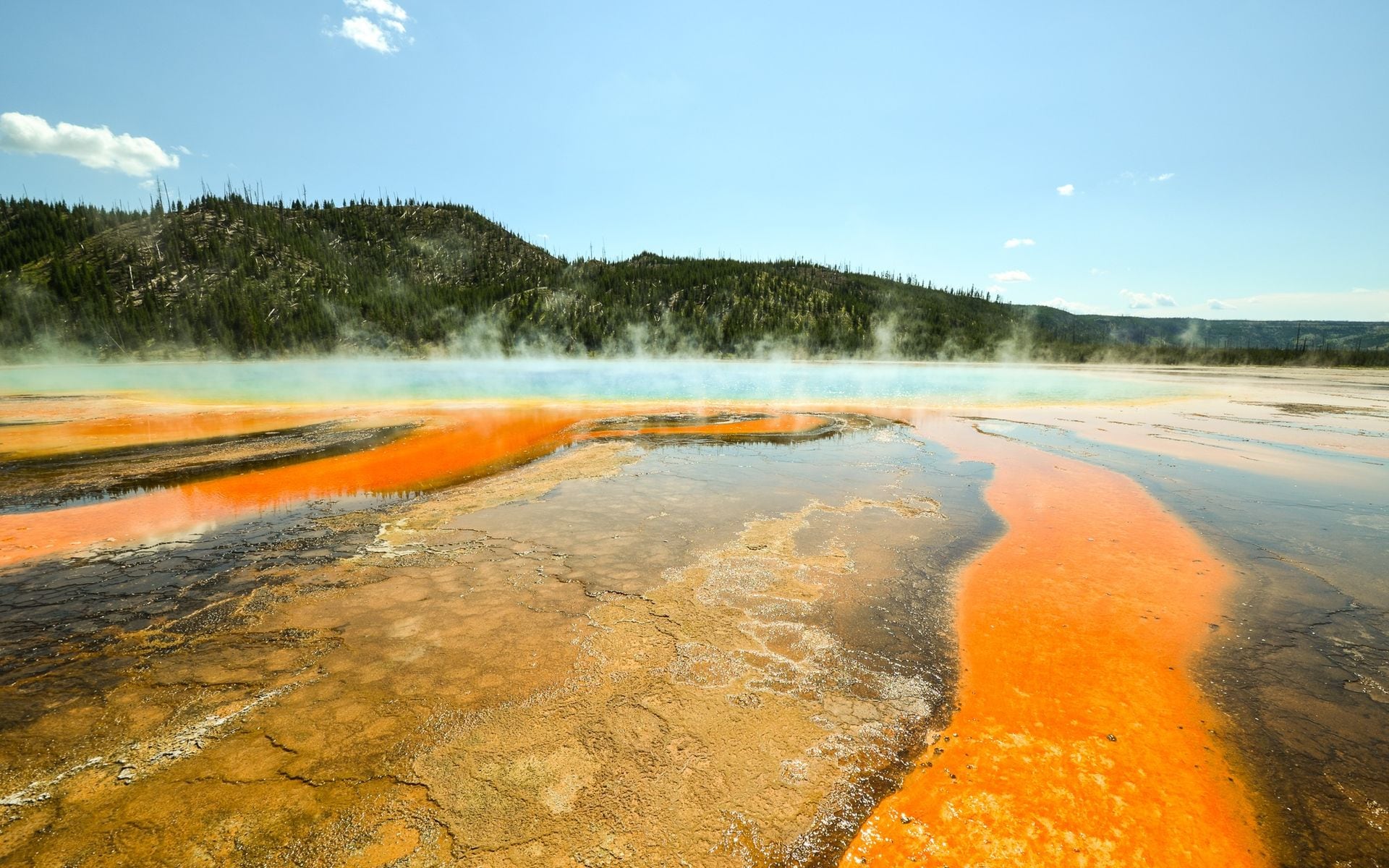
Old Faithful erupts roughly every 90 minutes, and the visitor center posts the next predicted eruption time so you can plan around it rather than just standing there. The Upper Geyser Basin surrounding Old Faithful holds more active geysers per square mile than any place on Earth. A few miles north at Midway Geyser Basin, Grand Prismatic Spring is a 370-foot-wide pool that runs blue in the center, green on the edges, and orange-red in the shallows where heat-adapted bacteria grow. The overlook trail on the south side of the road gives you an aerial perspective that the boardwalk at ground level can't match, most visitors skip it.
The Grand Canyon of the Yellowstone drops roughly 1,200 feet in two major falls. Upper Falls is the smaller of the two at 109 feet; Lower Falls drops 308 feet and is one of the largest waterfalls in the Rockies by volume. The canyon walls are a deep ochre yellow from iron oxides in the rhyolite, that's where the park's name comes from. Yellowstone Lake, at 7,733 feet elevation, is the largest high-elevation lake in North America. The north shore drive between Canyon Village and Fishing Bridge is worth it for spring grizzly sightings and waterfowl.
Getting There and Parking
Most Montana visitors fly into Bozeman Yellowstone International Airport (BZN), which is about 80 miles from Gardiner and about 90 miles from West Yellowstone, roughly 1.5 hours of driving either direction under good conditions. Bozeman is the practical base for a multi-day Yellowstone trip, with flights from most major US hubs and a wide range of hotels. The drive south from Bozeman through Paradise Valley on US-89 to Gardiner follows the Yellowstone River and is one of the better approach roads in the region. If you're staying near the ski terrain to the south, Big Sky is about 50 miles from the West Entrance at West Yellowstone, which makes a day trip or winter snowcoach outing workable without much extra driving.
Park entry costs $35 per vehicle for a 7-day pass, or you can cover all federal lands for the year with an $80 America the Beautiful annual pass, which pays for itself if you're also visiting Glacier on the same Montana trip. Yellowstone does not use timed-entry vehicle reservations, unlike Glacier, so you can drive through any open entrance without booking a window in advance. Parking at major sites fills early in summer; Old Faithful and Artist Point lots are often full by 8 a.m. in July. Overflow parking exists at Old Faithful but adds a walk. For a broader look at Montana's national parks, see National Parks in Montana.
Best Time to Go
June through August is the main visitor window when all five entrances are open and every facility is running. The full Grand Loop Road is accessible, wildflowers are out in the higher meadows by mid-July, and bear activity is high. The tradeoff is crowds: popular sites are packed by mid-morning, and in-park lodging and campgrounds are often sold out months ahead. If summer is your only option, start your days early. Sunrise in late June is around 5:30 a.m., and the first hour after the gates are open is noticeably quieter at every major stop.
September and October bring the elk rut, particularly visible near Mammoth and throughout the northern range. Bugling elk at dawn is as much a Yellowstone sound as geyser steam, and bull elk with full antlers are moving constantly during this period. The crowds thin considerably after Labor Day. Winter, from mid-December through March, is underrated: the North Entrance at Gardiner and the Northeast Entrance via Cooke City are the only two ways to reach the park by private vehicle in winter, the rest of the loop closes to cars. Snowcoaches and snowmobiles access the interior from West Yellowstone on groomed routes. Wolf pack behavior is easier to observe on snow-covered ground than in summer, and bison concentrate near the thermal features. Combining Yellowstone's winter wildlife with skiing in Yellowstone Country makes January and February genuinely compelling.
Good to Know
Cell service is spotty to nonexistent across most of the park interior. Download offline maps and the official NPS Yellowstone app before you leave your hotel, you'll use the app for geyser eruption predictions, trail conditions, and road alerts. Gas stations inside the park sit at Canyon Village, Grant Village, Fishing Bridge, and Tower Junction, but fuel is priced higher than at the gateway towns. Fill up in Gardiner, West Yellowstone, or Cooke City before you enter.
The park road speed limit is 45 mph, and bison jams are a real planning factor. A herd crossing the road can hold up traffic for 20 to 30 minutes, and they happen daily in the northern range. Budget extra time for any drive, especially on the Grand Loop between Mammoth and Tower. Bear spray is required in the backcountry and strongly recommended any time you leave your vehicle, even for short roadside stops. Distance rules from wildlife: stay at least 100 yards from bears and wolves, and at least 25 yards from bison and elk. Violating these rules carries fines and is also genuinely dangerous.
Don't try to cover everything in a single day. The Grand Loop alone takes four to five hours to drive without stopping, and you will stop often. Coming from Bozeman through Gardiner, a reasonable long day covers Mammoth, the Lamar Valley, and Tower Junction, roughly 80 miles of park road. Adding the geyser basins to that loop is not realistic in the same day. Two full days is a practical minimum; three gives you time to go back to the places you rushed through on day one.
Frequently asked questions
Does Yellowstone require timed-entry reservations like Glacier National Park?
No. As of 2025, Yellowstone does not require timed vehicle entry reservations at any entrance. You can drive in without booking a window in advance. What does require advance booking is lodging and campgrounds inside the park, popular sites fill months ahead for the summer season, and some open reservations as early as the previous spring.
What is the closest Montana airport to Yellowstone National Park?
Bozeman Yellowstone International Airport (BZN) is your best option. It sits about 80 miles from the North Entrance at Gardiner and 90 miles from the West Entrance at West Yellowstone, each roughly a 1.5-hour drive. BZN has the most nonstop flights from major US cities of any Montana airport, and Bozeman has the widest selection of hotels and services.
Can you visit Yellowstone from Montana in winter?
Yes. The North Entrance at Gardiner and the Northeast Entrance via Cooke City are the only two entrances open to private vehicles in winter, the rest of the loop is closed to cars from roughly November through April. The park interior is reachable from West Yellowstone by guided snowcoach or snowmobile on groomed routes. Winter is one of the better seasons for wolf watching in the Lamar Valley, and bison concentrate around the thermal areas near Mammoth.
Is the Lamar Valley in Montana or Wyoming?
The Lamar Valley is inside Yellowstone National Park in Wyoming, but you reach it through the Northeast Entrance via Cooke City, a small Montana town on US-212. The approach road through Cooke City is entirely in Montana, making this the most Montana-flavored entry into the park. It's also the least trafficked of the three Montana entrances, which is part of why the wildlife watching here is so good.
How much does it cost to enter Yellowstone?
A 7-day vehicle pass costs $35. The America the Beautiful annual pass is $80 and covers all federal lands for a full year, good value if you're also visiting Glacier National Park or any other federal site on your Montana trip. In-park lodges range from about $170 to over $500 per night depending on property and season. Campgrounds are $25 to $50 per night, and the most popular spots fill on the day reservations open.