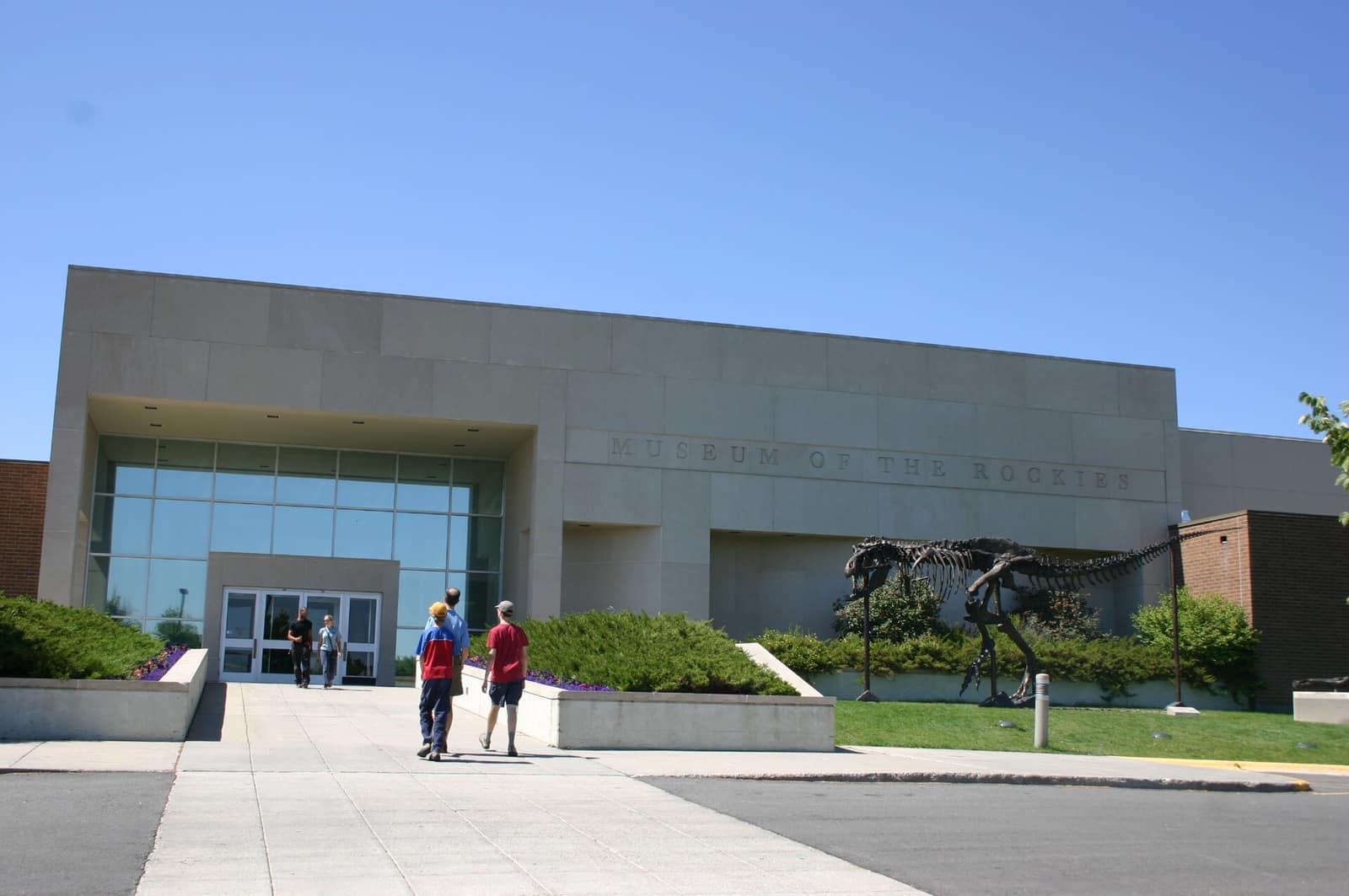
The Museum of the Rockies sits on the southwest edge of Montana State University’s campus in Bozeman, at 600 West Kagy Boulevard, about 1.5 miles south of downtown. It holds one of the largest collections of dinosaur fossils in the world, a regional history hall covering the northern Rockies from Indigenous history through the early 20th century, a digital planetarium, and a seasonal outdoor living history farm. For most visitors, it earns two to three hours. For families with children who have any interest in paleontology, it almost always runs longer. This guide covers what’s inside each section, what to prioritize if your time is short, and how the museum fits into a Bozeman day or a Yellowstone layover.
The Siebel Dinosaur Complex
Montana’s eastern badlands and plains are some of the most productive fossil-bearing ground in North America. The Hell Creek Formation, which runs across northeastern Montana into the Dakotas and Wyoming, has yielded more T. rex specimens than almost any comparable stretch of ground on the continent. A substantial portion of those specimens ended up at the Museum of the Rockies, and the Siebel Dinosaur Complex is where they live.
The collection holds more T. rex skulls in a single institution than anywhere else in the world. The centerpiece is MOR 555, known as the Wankel Rex: one of the most complete T. rex skeletons ever excavated, found in 1988 on a ranch in Garfield County in eastern Montana. The name comes from Kathy Wankel, the rancher who spotted the fossils eroding out of a hillside. The Wankel Rex spent a number of years on loan at the Smithsonian’s National Museum of Natural History in Washington, D.C., before returning to Montana permanently.
The exhibits are built around scientific process as much as spectacle. Displays explain how paleontologists read growth rings in bone cross-sections to determine an animal’s age at death, how comparative anatomy identifies species across fragmentary finds, and how interpretations of behavior have shifted as the fossil record has grown. One of the most significant threads running through the complex is the story of Maiasaura, a hadrosaur discovered at Egg Mountain in Teton County, Montana.
Egg Mountain was excavated by paleontologist Jack Horner, who worked at the museum for decades and is now one of the most recognized figures in North American paleontology. The site produced evidence of nesting colonies, juvenile animals in groups, and bone development patterns suggesting that adults fed and protected their young after hatching. That evidence overturned a longstanding assumption that dinosaurs were entirely non-parental, and the Maiasaura’s name, which translates roughly to “good mother lizard,” reflects that discovery. The museum tells this story in detail, with original specimens and interpretive panels that explain why the find mattered.
The complex also covers predator-prey relationships, the Cretaceous ecosystem of what is now Montana, and the K-Pg extinction event. If you’re the type of visitor who reads the panels rather than just walking past the big bones, plan for 90 minutes here. If you have children in the 6-to-14 range, the depth and scale of the exhibits typically hold their attention in a way that smaller natural history collections don’t.
Paugh History Hall
The Paugh History Hall covers the human geography of the northern Rockies and the Yellowstone region, running from Indigenous cultures through the fur trade era, homesteading, and into the early 20th century. Several galleries focus specifically on the Yellowstone ecosystem and its history as a tourism destination, covering the early survey expeditions that mapped the region, the establishment of the national park in 1872, and the growth of automobile tourism in the early 1900s. If you’re heading into the Yellowstone Country region after your time in Bozeman, these exhibits give you useful context on the area’s history before you get there.
Other sections focus on pioneer domestic life in the Gallatin Valley, with artifacts including period kitchen equipment, tools, and furniture from late 19th-century homesteads. One display traces the museum’s own institutional history through its predecessor Quonset hut museums, the original small collections that eventually consolidated into the current institution. There are also exhibits on Indigenous material culture and trading relationships in the region, though this portion of the hall is less developed than the dinosaur complex.
Paugh Hall is worth a walk-through if you want regional context for your Montana trip. Budget 30 to 45 minutes. It’s not the main draw, but the Yellowstone history sections in particular add something to a trip that includes the park.
The Taylor Planetarium
Inside the main building, the Taylor Planetarium runs dome projection shows on a digital full-dome system. Programming typically includes sky tours oriented to the current Montana night sky, astronomy education programs, and a rotating selection of feature-style films covering topics from solar system exploration to deep-space phenomena. Shows run roughly 45 to 60 minutes.
The planetarium charges separately from general museum admission, and seating is limited. On summer weekends and school holidays, shows fill up quickly. If a particular show interests you, buy your planetarium ticket when you purchase general admission rather than waiting.
Montana ranks among the lower 48 states with the most accessible dark skies. Once you’re outside Bozeman and Billings, the nights get dark quickly, and the Milky Way is visible without optical aid from most rural locations. If you plan to do any stargazing during your trip, from a campground in the Gallatin Canyon, a ranch in the Shields Valley, or a pullout on the Beartooth Highway, a planetarium show is a practical way to orient yourself before you get out there. For families with children roughly 7 and older, the shows are generally engaging and provide a good break from walking through exhibits.
The Tinsley Living History Farm
Adjacent to the main building, the Tinsley House is an 1880s homestead that operates as a seasonal living history site. From roughly late May through early September (hours and operating days vary; confirm on the museum’s website before you plan around it), interpreters demonstrate period farm and domestic work: tending a kitchen garden, operating hand tools, cooking on a period stove, and explaining the daily logistics of homesteading in the Gallatin Valley during the territorial era.
The farm is built for interaction rather than passive observation. Children can often participate in simple tasks alongside interpreters, which makes it more hands-on than exhibit hall content. The site is outdoors and weather-dependent; on cold or rainy days, programming may be reduced or canceled.
If you’re visiting in summer with children under 10, factor the farm into your schedule and give it 30 to 45 minutes. It’s particularly useful for the museum’s core audience of families, where younger children who aren’t fully engaged by fossil exhibits tend to find the outdoor, participatory format here more compelling. For adult visitors without children, it’s a pleasant addition when the weather is right and time allows, but it’s not an essential stop.
Practical Visit Information
The museum is at 600 West Kagy Boulevard, Bozeman, MT 59717. Parking is in the lot directly in front of the building. On weekdays during the Montana State University semester, the lot can partially fill with MSU commuter parking. There’s usually space within a short walk, but arriving before 10 a.m. on a busy summer weekday gives you the most options.
The museum is open year-round except Thanksgiving and Christmas. Summer hours run roughly 8 a.m. to 5 p.m.; winter hours are shorter. Planetarium shows have their own schedule, which changes by season and day. Check the current hours, admission pricing, and show schedule at museumoftherockies.org before you go.
The museum is a Smithsonian affiliate, part of the network of institutions that collaborate on collections and programming with the Smithsonian Institution. That affiliation has shaped both the depth of the collection and the quality of the interpretive approach.
Getting there from downtown Bozeman is straightforward: it’s about 10 minutes by car or rideshare south on South 7th Avenue, which connects to Kagy Boulevard. If you’re coming up from the south on US-191 from Yellowstone or Big Sky, take Kagy Boulevard west from US-191. There is no dedicated bus route from downtown, so a car or rideshare is the practical option. If you haven’t sorted out ground transport yet, see our guide to renting a car in Montana before you book.
Allow two to three hours for the Siebel Dinosaur Complex and Paugh History Hall. Add 45 to 60 minutes for a planetarium show, and 30 to 45 minutes for the living history farm if it’s operating and you’re visiting with children.
Adding the Museum to Your Bozeman Day
The museum works well as a half-day stop anchoring either end of a full day in Bozeman. The most common pattern is a morning at the museum followed by lunch on Main Street and an outdoor afternoon, or an outdoor morning followed by an afternoon at the museum when the midday heat makes trail time less comfortable.
Downtown Bozeman’s Main Street corridor, with independent restaurants, coffee shops, and gear shops, is about 10 minutes north of the museum by car. The stretch between 8th Avenue and Willson Avenue is the most concentrated. For an outdoor afternoon, Hyalite Canyon is 20 to 25 minutes south of Bozeman via South 19th Avenue and Hyalite Canyon Road. The canyon has Hyalite Reservoir for swimming and kayaking in summer, maintained hiking trails, a developed campground, and a beginner-accessible climbing crag near the reservoir.
For visitors doing a Yellowstone trip based out of Bozeman, the north entrance at Gardiner is about 80 miles south on US-89, roughly 90 minutes of driving. Many first-time Montana visitors fly into Bozeman Yellowstone International Airport (BZN), spend a day or two in the city, and then drive south to Yellowstone. The museum is a natural fit for that first day in town, particularly for families where the kids are old enough to get something out of the dinosaur exhibits. For more on the park, see Yellowstone National Park’s visitor information.
For the full picture on Bozeman, see our Bozeman travel guide. For planning with children, our Montana with kids guide covers what works and what to skip across the state. And if you’re still figuring out when to come, our best time to visit Montana lays out the tradeoffs by month.