The Short Answer
Glacier is all mountains: sharp peaks, glacial lakes, a single spectacular road crossing the Continental Divide, and more than 700 miles of trail packed into a compact park in the northwest corner of the state. Yellowstone is thermal and wide, covering 2.2 million acres of geothermal features, bison-clogged highway shoulders, and some of the most productive wolf- and bear-watching terrain in the lower 48. Both parks sit partly in Montana, both require at least two days to do any real justice, and both deal with genuine crowd problems from July through mid-August.
The clearest way to choose: go to Glacier if you want alpine hiking, a single iconic road experience, and glacial scenery you can reach on day hikes without backpacking. Go to Yellowstone if geysers, hot springs, and dense wildlife are the draw. If you have 10 or more days, you can reasonably do both. Start with the Montana Travel Guide if you're still mapping out the broader trip.
Quick comparison
| Factor | Glacier | Yellowstone |
|---|---|---|
| Size | 1,013,572 acres (about 1,583 sq mi) | 2,219,791 acres (about 3,468 sq mi) |
| Scenery | Alpine peaks, 25 named glaciers, 200-plus glacial lakes, 50-mile Going-to-the-Sun Road | Geothermal basins, Grand Canyon of the Yellowstone, high plateau meadows, roughly 500 geysers |
| Wildlife density | Good: grizzlies, mountain goats, moose, bighorn sheep, black bears | Exceptional: bison, wolves, grizzlies, elk, pronghorn, densest large-mammal concentration in the lower 48 |
| Crowds and reservations | Timed vehicle reservation required for Going-to-the-Sun Road, late May through Labor Day; lottery opens January on Recreation.gov | No timed entry system; interior lodging (Xanterra) books 6 or more months ahead for July and August |
| Nearest airport | Glacier Park International, Kalispell (FCA) | Bozeman Yellowstone International (BZN) |
| Drive time from airport | About 35 minutes to the West Glacier entrance on US-2 | About 90 minutes to Gardiner (North Entrance) via US-89, or about 90 minutes to West Yellowstone via US-191 |
| Days needed | 3 to 4 days to cover the main corridors; more for serious hiking | 3 to 4 days minimum to do the thermal basins and Lamar Valley; 2 days is a genuine rush |
| Best season | Late June through September; September for fall color and thinner crowds | May through early June and September; July and August peak crowds slow the interior roads |
What Glacier National Park Offers
Glacier sits inside the region known as Glacier Country, straddling the Continental Divide about 30 miles east of Kalispell. The park's signature experience is the 50-mile Going-to-the-Sun Road, which climbs from West Glacier at roughly 3,200 feet to Logan Pass at 6,646 feet before dropping to St. Mary on the eastern side. The road typically opens fully in late June or early July, and it closes when heavy snow arrives, usually in October. That summer window is short, and demand for it is high.
Outside that road corridor, you have trails like the Highline Trail along the Continental Divide from Logan Pass, the 7.6-mile round trip to Grinnell Glacier in the Many Glacier valley, and a quieter trail network in the Two Medicine area that most visitors never find. The 4.5-mile round trip to Hidden Lake Overlook from Logan Pass is one of the most accessible above-treeline hikes in any national park: paved boardwalk for the first mile, then gravel to the overlook at 7,000 feet, with mountain goats often visible on the talus slopes to the north. The 11.4-mile Ptarmigan Tunnel route from the Swiftcurrent Trailhead leads through a hand-carved passage in the rock wall above Ptarmigan Lake, one of the park's less-traveled long routes.
Wildlife in Glacier includes grizzly bears, black bears, mountain goats on the cliff faces near Logan Pass, moose in the willow flats around Swiftcurrent Lake, and bighorn sheep across the east side of the park. NPS population estimates put roughly 300 grizzly bears in and around Glacier's boundaries. Whitefish, about 30 minutes west of the West Glacier entrance, and Kalispell are the closest full-service towns for lodging and restaurants.
For lodging inside the park, Glacier Park Collection operates Lake McDonald Lodge on the west side, Many Glacier Hotel in the northeast valley, and Swiftcurrent Motor Inn in the Many Glacier area. All three book out quickly, particularly Many Glacier Hotel, which fills for peak summer weekends by March or April. The park also has campgrounds at Apgar, Fish Creek, Sprague Creek, Avalanche, St. Mary, and Many Glacier, with reservations on Recreation.gov. There are no gas stations inside Glacier, so fill up in Whitefish, Kalispell, or St. Mary before entering.
What Yellowstone National Park Offers
Yellowstone covers 2.2 million acres across mostly Wyoming, but three of the five park entrances sit on the Montana side. Gardiner on the north (US-89) is the only entrance open to wheeled vehicles year-round and the most-used gateway from Bozeman. West Yellowstone on the west (US-20/US-191) is the other primary Montana entry point, with a full town of hotels, outfitters, and gear shops built around park traffic. Cooke City on the northeast (US-212) offers the most dramatic approach if you're coming over the Beartooth Highway from Red Lodge, though that route closes in winter and typically reopens around Memorial Day.
The park holds roughly 500 geysers, more than half the world's total, plus thousands of hot springs, mud pots, and fumaroles. The Grand Canyon of the Yellowstone cuts through the central section with its Upper and Lower Falls. Wildlife density is what separates Yellowstone from every other park in the country: bison herds regularly stop traffic on the interior loop roads, and the Lamar Valley in the northeast corner is the most reliable wolf- and grizzly-watching corridor in the lower 48. Two days is the honest minimum to cover the major thermal basins and get a proper morning in the Lamar Valley.
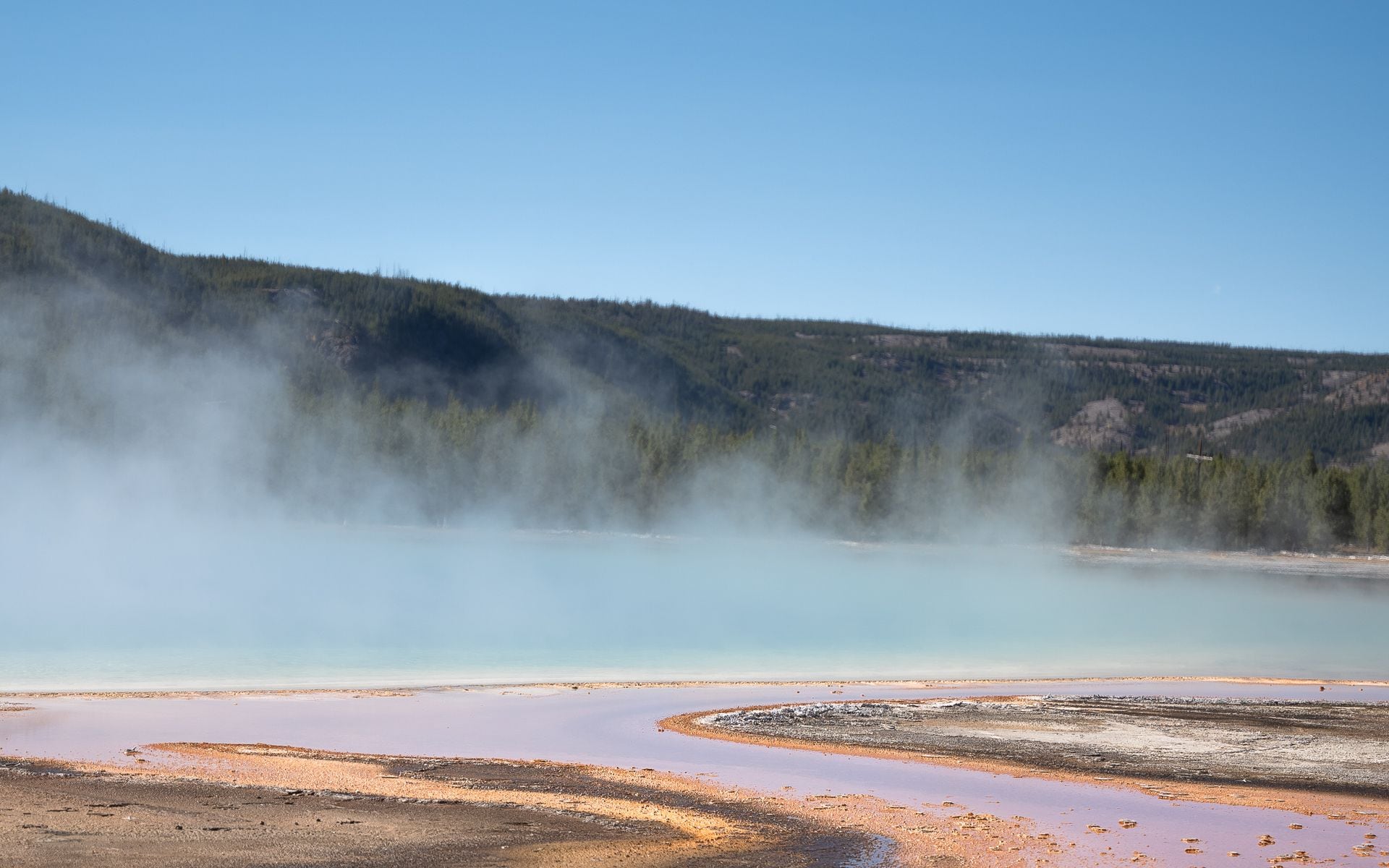
The park's thermal areas each have a distinct character. The Upper Geyser Basin around Old Faithful holds the highest concentration of active geysers, with Old Faithful erupting roughly every 90 minutes to heights between 106 and 185 feet. The Norris Geyser Basin, about 21 miles north of Old Faithful, is the hottest and most geologically active part of the park, with Steamboat Geyser capable of eruptions exceeding 300 feet when it cycles. The Midway Geyser Basin holds Grand Prismatic Spring, the largest hot spring in the United States at roughly 300 feet across, best viewed from the overlook trail on the hillside above the main boardwalk.
Xanterra operates lodging inside the park. Old Faithful Inn, Canyon Lodge, Lake Yellowstone Hotel, and Mammoth Hot Springs Hotel are the main options. Old Faithful Inn is the largest log structure in the world by floor area and among the most fully booked properties in the national park system. The 12 campgrounds inside the park range from RV sites with electrical hookups at Fishing Bridge RV Park to tent-only primitive camping at Slough Creek and Pebble Creek near the Lamar Valley, both of which offer the closest base camp for early-morning wolf watching. Gas is available inside the park at Canyon, Fishing Bridge, Grant Village, and Tower-Roosevelt, but typically runs $0.50 to $1.00 per gallon higher than Gardiner or West Yellowstone prices outside the boundary.
Crowds, Reservations, and Timing
The reservation logistics are completely different at each park. Glacier uses a timed vehicle reservation (TVC) system for Going-to-the-Sun Road and several other corridors during peak summer, generally from late May through Labor Day weekend. The TVC lottery for most summer dates opens on Recreation.gov in January and February. If you miss the lottery, a smaller batch releases at 8 a.m. Mountain Time each morning for the same day and a few days out. Planning your Glacier trip six or more months out is not excessive. See Park Reservations and Permits before you lock in your dates.
Yellowstone does not use a timed entry system, but lodging inside the park (operated by Xanterra) books out months ahead, and campgrounds fill by mid-morning on peak summer days. If you want a room at Old Faithful Inn or Canyon Village in July, book in January. The most practical off-season timing is mid-May through early June at Yellowstone, when crowds are lighter and wolf packs are active, and September at Glacier, when larches turn gold in the higher valleys, traffic on the Going-to-the-Sun Road thins out, and the elk rut begins. For a full breakdown of each month, see Best Time to Visit Montana.
Visitor numbers give a sense of scale. Glacier draws roughly 3 million visits per year in recent seasons, with the peak concentrated in a 6-week window in July and August when the Going-to-the-Sun Road is fully open. Yellowstone regularly sees 4 to 5 million visitors annually, and its figure-eight road loop distributes that traffic more evenly than Glacier's single corridor. Both parks are noticeably quieter after Labor Day, and both see a smaller secondary crowd in October before snow closes roads.
Getting There: Airports and Drive Times
For Glacier, fly into Glacier Park International in Kalispell (FCA). The West Glacier entrance is about 30 miles east of Kalispell on US-2, roughly a 35-minute drive. Whitefish sits even closer to the park and generally has more lodging and dining options per block than Kalispell. For Yellowstone, Bozeman Yellowstone International (BZN) is the right airport: the state's busiest, best-connected, and the one with the most competitive fares. Gardiner, the North Entrance, sits roughly 80 miles north of Bozeman on US-89 through Paradise Valley, about 90 minutes of driving. West Yellowstone is about 90 miles from BZN on US-191 through Gallatin Canyon, a similar time.
If you want to visit both parks in one road trip, plan for a full day between them. The most direct route from West Glacier to Gardiner runs roughly 380 miles and takes about 6 hours via I-15 south through Great Falls, then southeast on I-90 and US-89. A practical option is to break that leg with a night in Bozeman, which sits almost exactly midway and has good restaurants and easy lodging.
For FCA, Alaska Airlines, Delta, and United serve Kalispell from West Coast hubs and Seattle (SEA is about a 90-minute flight) during the summer season, with service typically expanding from May through September. For BZN, Delta, United, American, Southwest, and Alaska fly direct from hubs including Atlanta, Minneapolis, Denver, Dallas, Chicago, and Los Angeles. Both airports see higher fares June through August; booking 3 to 4 months ahead is realistic for reasonable prices.
Practical Tips
An America the Beautiful annual pass ($80/year, sold at entrance stations and online at usgs.gov/store) covers entry fees at both Glacier and Yellowstone. Individual 7-day vehicle passes at each park run approximately $35 as of recent seasons, so the annual pass covers itself in fewer than three total park visits. If you're doing both parks on one trip, buy it before you arrive.
Carry bear spray at both parks and know how to deploy it. Glacier and Yellowstone are active grizzly country, and food storage rules and wildlife distance requirements apply everywhere. The Wildlife and Bear Safety page covers the specifics. One more thing worth knowing at Yellowstone: the Lamar Valley produces the best wolf and grizzly sightings at dawn and dusk. Arriving after 9 a.m. on a summer day is a different, much quieter experience. At Glacier, the Many Glacier valley and Two Medicine area offer comparable hiking and wildlife to the Going-to-the-Sun corridor with a fraction of the vehicle traffic.
Cell coverage is patchy at both parks. Download offline maps via Gaia GPS, AllTrails, or Maps.me before you arrive and pick up the NPS paper maps at entrance stations. At Yellowstone, free Wi-Fi at visitor centers in Albright (Mammoth), Canyon, Fishing Bridge, Grant, Madison, and Old Faithful handles the basics when you're in range. At Glacier, the NPS app includes real-time timed entry updates for the Going-to-the-Sun Road corridor.
Frequently asked questions
Can you visit both Glacier and Yellowstone in one Montana trip?
Yes, but give it at least 10 days. The drive between the parks is roughly 6 hours (West Glacier to Gardiner), so plan a full travel day between them. A practical split is 3 to 4 days at Glacier, one driving day with a night in Bozeman, and 3 to 4 days at Yellowstone. Bozeman works well as a midpoint and has BZN airport for mid-trip fly-ins or departures.
Do you need reservations to drive Going-to-the-Sun Road?
Yes, during peak summer. Glacier National Park requires timed vehicle reservations for the Going-to-the-Sun Road corridor and a few other areas from roughly late May through Labor Day weekend. The lottery for most dates opens on Recreation.gov in January and February. A daily release at 8 a.m. Mountain Time covers same-day and near-future dates, but availability is thin in July. See Park Reservations and Permits for current details. Yellowstone has no timed entry requirement, though lodging and campgrounds inside the park book up fast.
Which park is better for wildlife watching?
Yellowstone, by a significant margin, for density and variety. The Lamar Valley in the northeast section produces wolf, grizzly bear, bison, pronghorn, and elk sightings with a regularity that no other corridor in the lower 48 matches. Glacier has real wildlife, particularly mountain goats near Logan Pass, grizzlies in the Many Glacier valley, and moose around Swiftcurrent Lake, but you're earning those sightings rather than driving into the middle of them.
Which park is easier with young kids?
Yellowstone is generally more accessible for young children. The geyser basins and thermal features involve short, flat boardwalk walks from large parking areas, Old Faithful is a reliable visual payoff, and the Lamar Valley wildlife show requires nothing more than binoculars from a pull-off. Glacier's best experiences involve longer hikes with real elevation gain. That said, the Apgar and Lake McDonald areas near Glacier's West Entrance offer easy waterside walks and good scenery for any age.