What to Expect
Lewis and Clark Caverns State Park sits on Highway 2 in Jefferson County, between the small town of Whitehall to the west and Three Forks to the east. The park anchors a stretch of Southwest Montana that follows the Jefferson River corridor, the same drainage that Meriwether Lewis and William Clark followed upstream in 1805 on their way to the Missouri headwaters. The expedition never entered the cavern, but they camped in the area, and the name held when homesteaders discovered the cave in the early twentieth century and the state took it over in 1937.
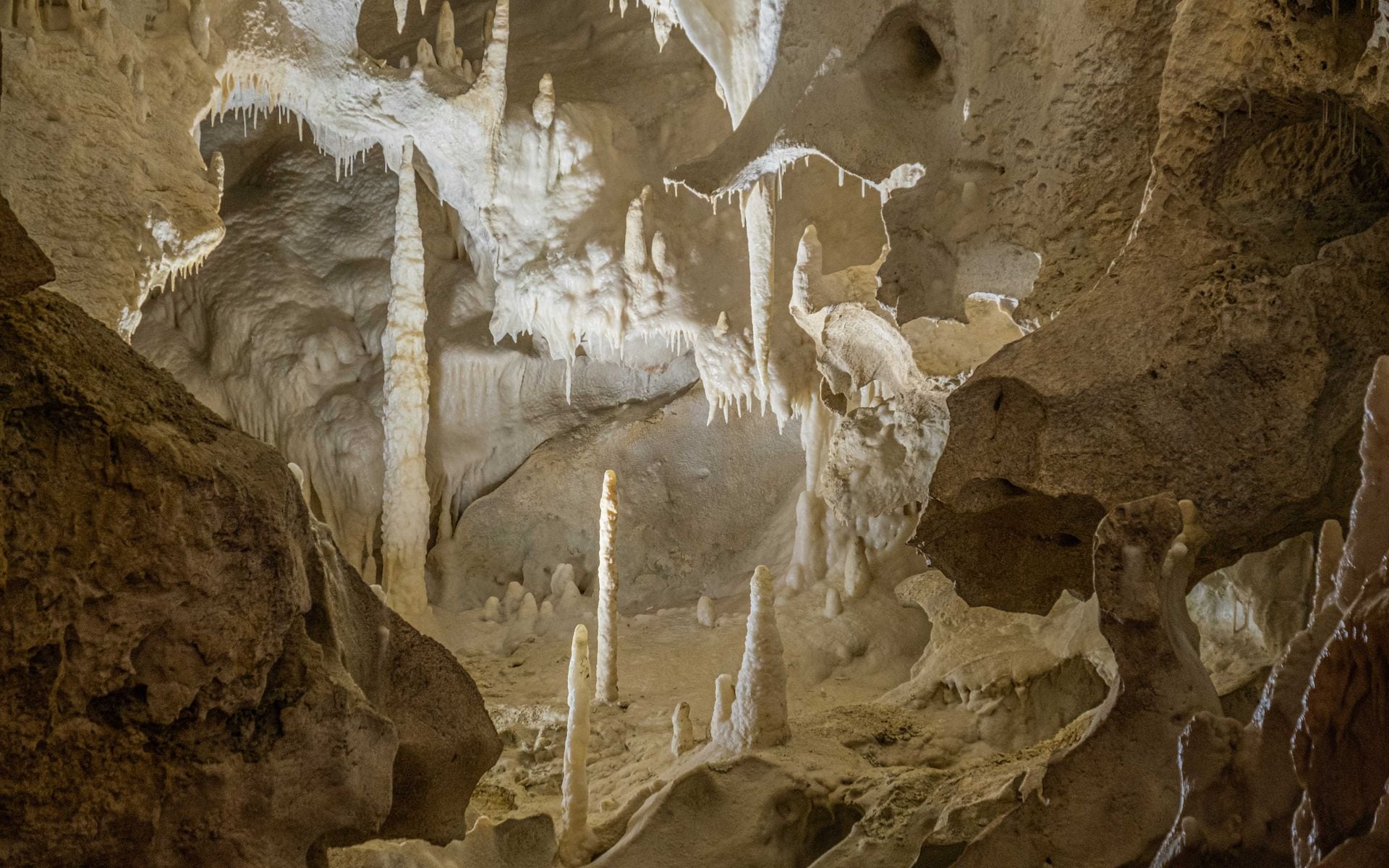
The cavern runs through a limestone ridge above the Jefferson River valley. Inside, the temperature holds steady at about 50 degrees Fahrenheit year-round. That fact surprises visitors arriving in July heat and rescues visitors who underestimated May chill. The cave contains stalactites hanging from the ceiling, stalagmites building up from the floor, flat sheets of flowstone draped across the walls, and helictites, a formation type that spirals outward in all directions without regard to gravity. Some chambers open wide enough that your headlamp doesn't reach the far wall. Others narrow down to passages you move through sideways or crouched. That range is what holds attention over two hours underground.
This is not a showpiece cave with tinted LED lighting and a paved walkway. It is an actual limestone cavern, and the tour engages with it honestly. Expect to work a little, look a lot, and leave slightly dusty.
What to Do There
The Classic Tour is the reason most people stop, and it delivers. It runs roughly two hours and covers the full cavern route from the entrance chambers through the deepest accessible sections. Groups are kept small, the pace is measured, and the ranger leading the tour knows the geology well enough to explain what you're looking at without making it feel like a lecture. Expect some metal stair sections, a few passages where you'll duck or turn sideways, and elevation changes that add up to around 600 feet inside the cave. Closed-toe shoes are required. A light jacket or fleece is genuinely necessary; the 50-degree temperature drops your body heat within ten minutes regardless of what you wore on the drive in.
On select summer evenings, the park offers Candlelight Tours where electric lights are replaced by candles placed along the route. The experience is quieter and stranger in a good way, and worth planning around if you can get a spot. These book up weeks ahead in July and August, sometimes faster.
Above ground, the park has about seven miles of hiking trails through the dry, grassy hills above the river. The Cave Gulch trail climbs to the cavern entrance and opens views across the Jefferson River valley. The Jefferson itself holds brown and rainbow trout, and some visitors fish the river in the morning before their afternoon tour. The park campground has approximately 40 sites, some tipi rentals (an unusual offering for a Montana state park), and picnic tables along the river. An overnight stay gives you enough time to hike before and after the cave.
One detail most first-timers miss: the cavern entrance is visible from the parking area if you look up the limestone ridge. That view gives you a quick read on the geology before you go underground, and it's worth a minute to look before boarding the shuttle.
Getting There and Parking
From Bozeman, take I-90 west to the Three Forks interchange, then Highway 2 west for about 19 miles. The total drive from downtown Bozeman is roughly 50 miles and takes just under an hour in normal conditions. From Helena, take I-15 south to the Whitehall exit, then Highway 2 east for a total of roughly 65 miles and about 75 minutes of driving. From Three Forks, the drive is 19 miles straight west on Highway 2. The park entrance is clearly signed from both directions.
Park in the main lot near the visitor center. You cannot drive to the cave entrance. The park uses a shuttle vehicle to carry visitors up the hillside to the cavern mouth, and it departs at your reserved tour time. Arrive at least 15 minutes early; rangers close the group and leave on schedule. State park day-use fees apply in addition to the cave tour fee. Current estimates: roughly $6-8 per vehicle for day use (non-resident rate), and approximately $10-12 per adult for the Classic Tour. Children's rates are lower. Montana residents pay a different rate. Check the official Montana State Parks site for current-season pricing before you go, since fees adjust periodically.
Best Time to Go
Cave tours run from mid-May through late September. July and August are the busiest months, with multiple tour departures daily and weekend slots filling up one to two weeks ahead. If you're visiting in peak summer, book online through Montana State Parks as soon as your dates are set. Walk-ins sometimes get in on weekday mornings when volumes drop, but it's not a reliable plan in July.
May and September offer a noticeably quieter experience without any real sacrifice in the cave itself. The formations don't change, the temperature doesn't change, and the tour is the same. What changes is that you're sharing the route with fewer people, and the ranger can move at a more relaxed pace. September pairs well with the surrounding southwest Montana landscape, when the hillsides turn gold and the Jefferson River corridor is at its most photogenic. If you're building a road trip through the Butte area, Dillon, or the ghost town of Bannack State Park, September timing threads all of those stops together cleanly.
Good to Know
Lewis and Clark Caverns is one of the best state parks in Montana for travelers who want something genuinely different from a trailhead or a viewpoint. The cave is the whole point, and two hours underground gives you a complete experience. You don't need a second day here unless you're camping, fishing, or hiking the surface trails in addition to the tour.
The Classic Tour is not wheelchair-accessible and is not appropriate for strollers or anyone with significant mobility limitations. The two miles of cave passage include uneven stone floors, metal stairs, and sections requiring crouching. Children who can walk a mile on their own handle it well. Many kids find tight cave passages more engaging than any scenic overlook, partly because the scale is different and partly because the ranger makes it interactive.
What to bring: a jacket (essential), water, and closed-toe shoes with traction. Leave large backpacks and bags in the car since there's no storage at the cave entrance and you'll be maneuvering through tight spaces. Photography inside the cave is allowed but tripods aren't practical on the tour. A wide-angle lens or phone camera works fine in the larger chambers.
Frequently asked questions
Can you visit Lewis and Clark Caverns without a guided tour?
No. The cavern is only accessible through a ranger-led tour. There is no self-guided option and no open access to the cave passages on your own. The guided format is part of how the park manages both safety and the formations themselves. If you want to visit the park without doing a tour, you can hike the surface trails and access the Jefferson River without a tour reservation, but the cave itself requires booking a tour slot.
How long does the cave tour take, and how physically demanding is it?
The Classic Tour runs about two hours and covers roughly two miles of cave passage. It involves walking on uneven stone, climbing metal stairs, and ducking through sections where the ceiling drops. The elevation change inside the cave is around 600 feet. It's suitable for reasonably fit adults and kids who can walk a mile on their own. The main demands are staying low in tight passages and keeping pace with the group. It is not strenuous in a cardio sense, but it is not a flat, easy walk either. Wear closed-toe shoes with grip and bring a jacket; the cave stays at 50 degrees Fahrenheit all season.
Is Lewis and Clark Caverns worth a stop if you're just driving through the area?
Yes, if you have three hours to spare and can book a tour slot that lines up with your drive. The cavern sits right along the Highway 2 corridor between Three Forks and Whitehall, which puts it close to I-90 and within about an hour of Bozeman or Helena. It adds a genuinely different experience to a Southwest Montana road trip that might otherwise be a series of scenic drives and historic markers. The combination of the Jefferson River setting and the underground tour makes it more memorable than most half-day stops in the region.
Are there places to stay near Lewis and Clark Caverns?
The park itself has a campground with approximately 40 sites, including some tipi rentals, and it's a reasonable option in summer if you book ahead. For motel or hotel lodging, Whitehall (about 8 miles west) and Three Forks (about 19 miles east) both have basic options. Bozeman, about 50 miles east, offers the widest range of lodging at all price points and makes a practical base if you're combining the caverns with a broader trip to the Yellowstone region or Big Sky.